The questions that separate a one-off script from work your team can actually own: scope, reproducibility, code ownership and handover.
Author
Rverse Analytics
Published
July 8, 2026
Hiring help with an analysis is easy; hiring help you don’t regret in six months is harder. The difference is rarely statistical skill — it’s how the work is delivered. Here is what we’d ask before signing anything.
Will you own the code — or just the output?
A results table is a dead end. A script that produces the table is an asset: rerun it on cleaned data, adapt it for the next study, hand it to a colleague. Ask explicitly whether you receive the code, whether it runs end-to-end from raw data, and whether you’re free to reuse it. If the answer is “we’ll send you the figures,” you’re renting, not owning.
Is it reproducible, or a pile of manual steps?
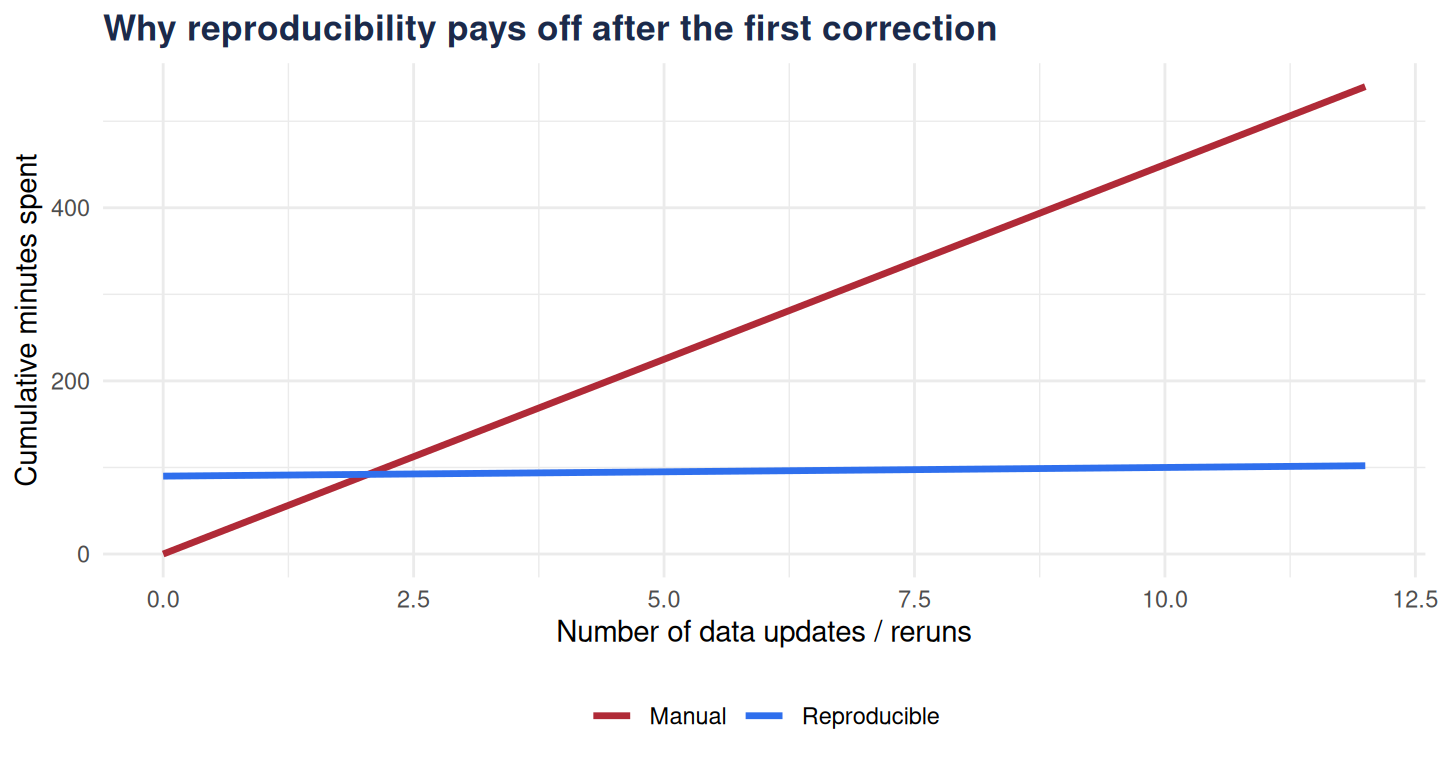
“Reproducible” has a concrete test: can someone else regenerate every number and figure with a single command? A good pipeline makes the cost of a data correction almost zero — rerun and you’re done. A bad one makes it a day of re-clicking. The economics compound over a project’s life:
library(ggplot2)reruns <-0:12manual <-45* reruns # ~45 min of clicking each timereproducible <-90+1* reruns # one-off setup, then ~1 min per rerund <-data.frame(reruns =rep(reruns, 2),minutes =c(manual, reproducible),workflow =rep(c("Manual", "Reproducible"), each =length(reruns)))ggplot(d, aes(reruns, minutes, colour = workflow)) +geom_line(linewidth =1.2) +scale_colour_manual(values =c(Manual ="#b02a37", Reproducible ="#2f6fed")) +labs(title ="Why reproducibility pays off after the first correction",x ="Number of data updates / reruns", y ="Cumulative minutes spent",colour =NULL ) +theme_minimal(base_family ="sans") +theme(legend.position ="bottom",plot.title =element_text(face ="bold", colour ="#1b2a4a"))
Figure 1
The reproducible line starts higher — there’s real setup — and then barely moves. Any project touched more than once comes out ahead.
Is the scope in writing?
Vague scope is where consulting relationships go wrong. Before work starts you should have, in writing: the question, the data, the deliverable, the timeline and the price. Fixed-scope milestones beat an open-ended hourly meter for everyone — you know the cost, and the consultant knows what “done” means.
Will there be a handover?
The last hour of a good engagement is a walkthrough: here’s the code, here’s how to rerun it, here’s what to change if your data grows. Without it, you inherit a black box. With it, your team is genuinely more capable than before.